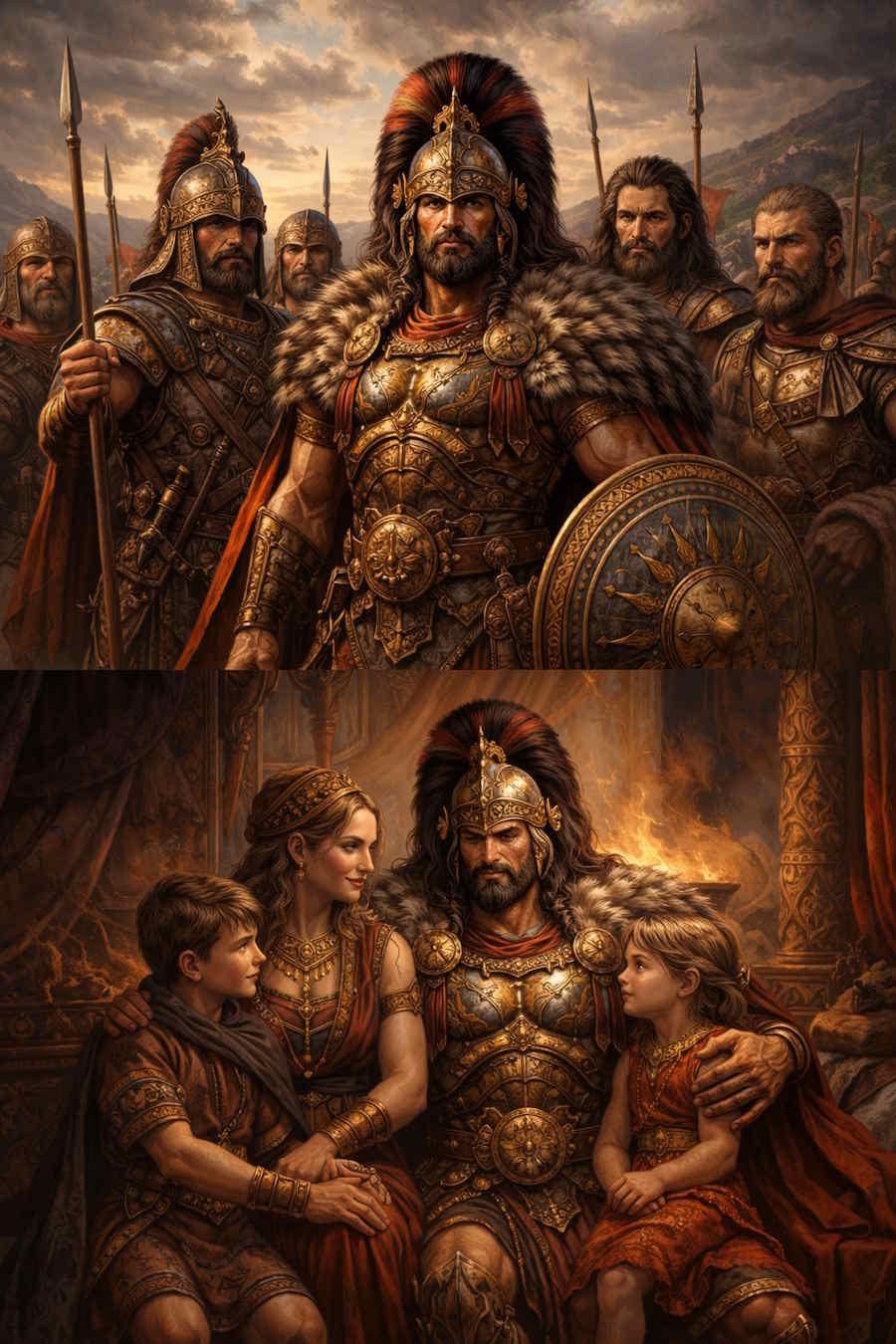
Oloros (Greek: Ὄλορος) was a Thracian king or dynast who lived in the late 6th to early 5th century BCE. What we know about him comes mainly from Greek historical sources, especially through his connections to Athens, rather than from Thracian records themselves.
Who was Oloros?
- Oloros ruled over a Thracian kingdom or tribal territory, probably in
eastern Thrace or near the Strymon River region (modern northern Greece/southern Bulgaria). - Thrace at this time was not a unified state but a patchwork of powerful warrior kingdoms, often interacting with (and sometimes fighting) Greeks and Persians.
- Thracian kings were known for their military strength, wealth in gold and silver, and strong aristocratic families.
Connection to Greece
Oloros is best known because of his family ties to famous Greeks:
- He was the father of Hegesipyle, a Thracian princess.
- Hegesipyle married Miltiades the Elder, an Athenian nobleman and ruler of the Thracian Chersonese.
- This made Oloros the grandfather of Miltiades the Younger, the Athenian general who defeated the Persians at the Battle of Marathon (490 BCE).
- Through this lineage, Oloros was also an ancestor of the historian Thucydides,who explicitly mentions his Thracian heritage.
Historical Significance
- Oloros is not recorded as a conqueror or empire-builder, but as a powerful regional king whose family held prestige and influence.
- His importance lies in showing how Thracian and Greek elites intermarried, forming political alliances.
- Thucydides’ Thracian ancestry suggests that Oloros’ family was remembered for generations as noble and influential.
What We Do Not Know?
- No surviving Thracian texts describe his reign.
- His exact capital, battles, or laws are unknown.
- Most artistic reconstructions of Oloros are historically inspired but imaginative,
based on Thracian warrior culture.
Summary
Oloros was:
- A Thracian king or dynast
- Active around 500 BCE
- A key link between Thracian and Greek aristocracy
- An ancestor of Miltiades and Thucydides
- Historically real, but only fragmentarily documented